


Your Aerospace and Defense Electronics Tariff Exposure, Quantified by HTS Code
Tariff rates, trade flow analysis, and corridor risk for avionics, radar systems, electronic warfare components, satellite electronics, and military-grade power supplies.
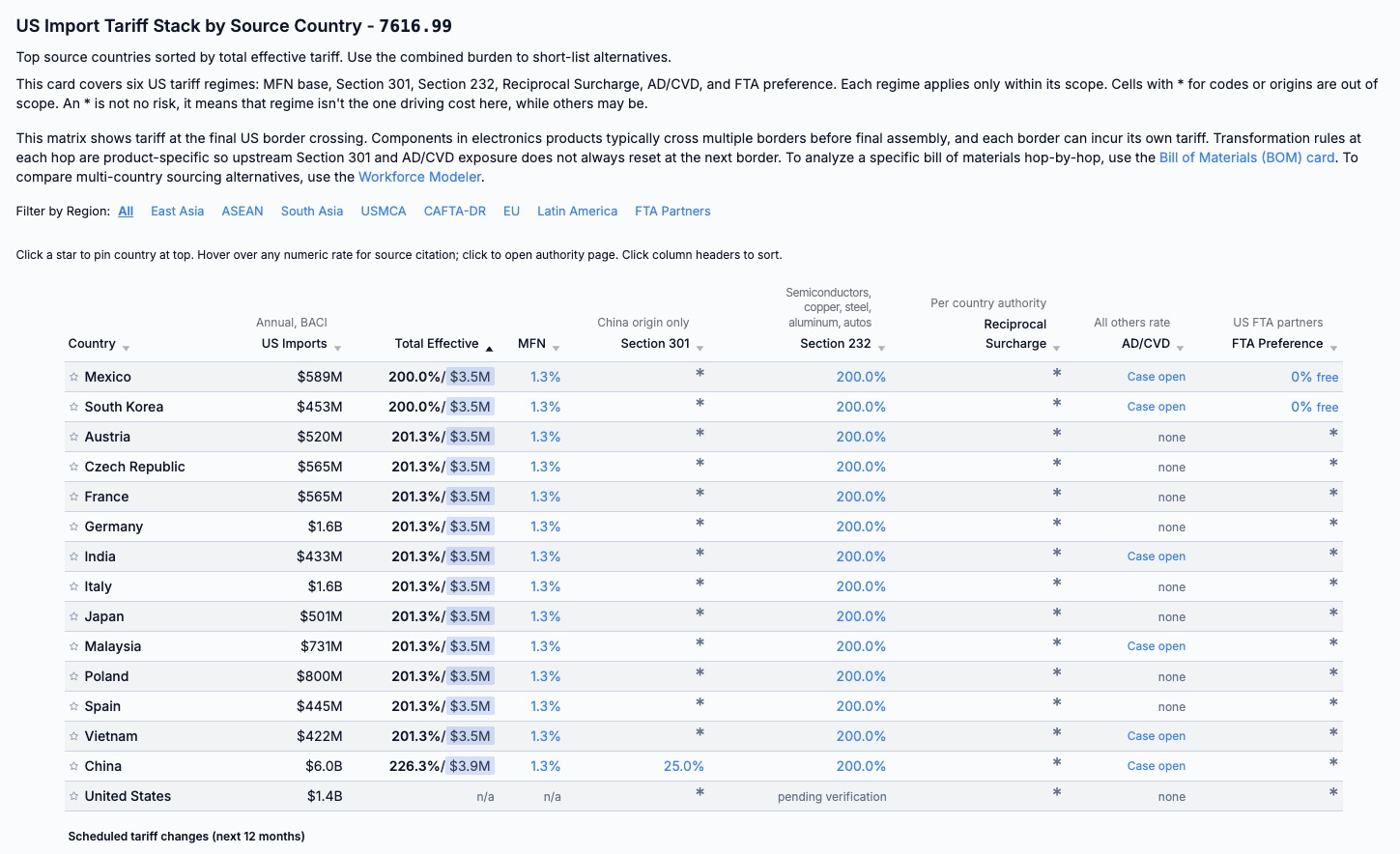
Avionics enclosures, radar housings, satellite chassis, and missile compartment shielding face a 200% Section 232 surcharge from every major source country, plus active AD/CVD orders against China, Korea, and Vietnam. TariffVault surfaces the combined burden across countries, regimes, and forward-looking risk in a single matrix.
Look Up Your HTS Code. Free.
View Pricing
Enter any HTS code. No login. No credit card. Results in seconds.
Defense Electronics Procurement Faces a Three‐Layer Tariff Problem
DFARS domestic sourcing rules, ITAR and EAR export controls, and program lifecycle lock-in compound tariff exposure across the life of every program.
DFARS and Domestic Sourcing Requirements
DFARS requires US-origin or qualifying country sources for many defense electronics. Section 301 still applies when Tier 2 or Tier 3 inputs are Chinese, even when the final assembly origin is DFARS-compliant. Qualifying country status does not mean zero tariff. Japan, UK, Germany, and other allied origins still enter at MFN rates that vary by HTS code. The Berry Amendment layers further domestic content requirements onto certain inputs in defense assemblies.
ITAR/EAR Compliance Layered on Tariff Complexity
ITAR and EAR restrict which countries can supply defense electronics. The intersection of export controls and tariff schedules narrows the compliant, tariff-advantaged supplier pool sharply. Qualifying a new supplier requires security clearances, facility audits, and program-specific approvals. A tariff-driven supplier change costs far more than the tariff delta alone suggests.
Program Lifecycle Lock‐In Amplifies Tariff Exposure
Defense programs run 20-30+ years. Components qualified at program start carry through production, sustainment, and obsolescence management. Switching mid-program requires requalification testing, MIL-STD compliance verification, and contracting officer approval. Tariffs on qualified sources compound across every year of the program with no practical ability to switch.
From HTS Code to Sourcing Strategy
Start free with any HTS code. The paid tier opens the full atlas and modeler.
One license includes all tools and features. One-time payment. No subscriptions. No auto-renewals.
Built for the Decisions Defense Electronics Buyers Actually Make
Avionics PCBA Sourcing Across Allied Country Alternatives
Qualified suppliers in DFARS qualifying countries (UK, Australia, Japan, Korea) offer compliant alternatives for avionics PCBAs. Section 301 still applies when subcomponents from China flow through multi-tier supply chains, even when the final assembly origin is DFARS-compliant. The report shows the tariff rate per origin and HTS classification. The modeler quantifies the total landed cost delta across qualifying country alternatives.
Radar and EW Component Sourcing
Specialty RF components and GaN and GaAs semiconductors come from a small set of global sources. ITAR and EAR restrict that pool further to allied nations. Tariff treatment varies by country of origin and end-use classification. The report identifies the tariff rate per origin for each component HTS code. The atlas shows corridor risk and concentration exposure for the narrow set of compliant sourcing lanes.
Satellite Electronics and Space‐Grade Components
Radiation-hardened ICs and space-qualified passives come from a very small set of suppliers. Single-source dependencies mean tariff exposure cannot be mitigated through diversification. The report shows tariff treatment by origin for rad-hard component classifications. The modeler quantifies the lifecycle tariff burden when no alternative supplier exists and the full tariff must be absorbed across production and sustainment.
From the Team Behind VentureOutsource.com
VentureOutsource has reported on contract electronics manufacturing sourcing for over two decades, read by OEM and EMS sourcing teams across the industry.
“I am impressed with the valuable expertise Venture Outsource has obtained on the industry. They command a good depth of knowledge with useful industry insight. Just what I expect from a reliable firm.”
Robert Kronser, CTO, Plexus
See What Your HTS Code Actually Costs You
No login. No credit card. Enter your HTS code and see what it actually costs.
DFARS domestic sourcing rules, ITAR supply chain constraints, and Section 301 tariffs create a three-layer tariff burden on defense electronics procurement. The cost compounds across every year of a program’s lifecycle.
Run Report
8526.10.0040
8525.60.0010
8542.31.0001
9014.20.4080
View Pricing
One-time payment. No subscriptions. No auto-renewals.