


Your Robotics and Automation Tariff Exposure, Quantified by HTS Code
Tariff rates, trade flow analysis, and corridor risk for complete robotic systems, AMRs, cobots, vision systems, and automation components.
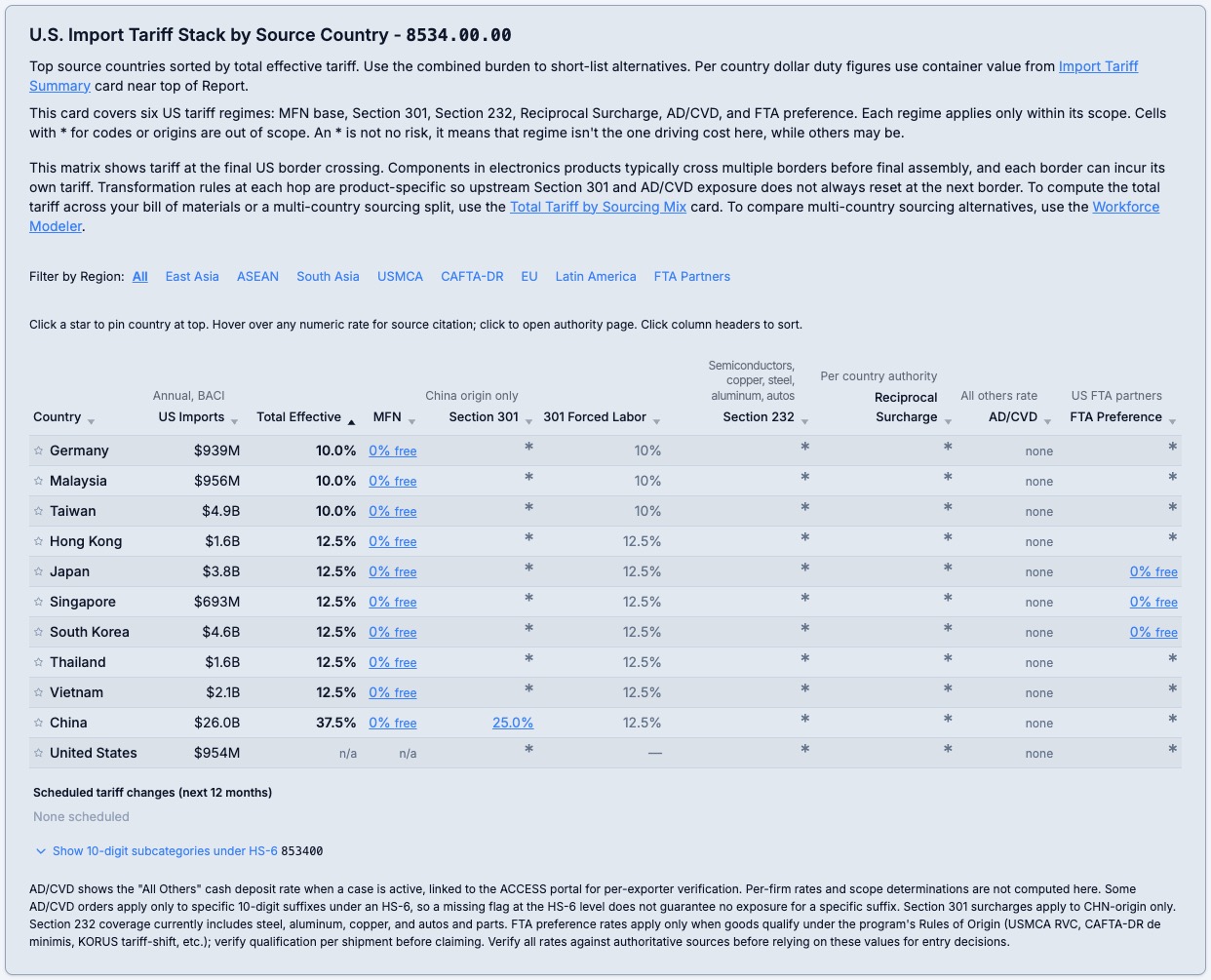
Robot arm housings, gripper chassis, end-of-arm tooling brackets, and controller enclosures face a Section 232 surcharge from every major source country, plus active AD/CVD orders on key electronics-sourcing origins. TariffVault surfaces the combined burden across countries, regimes, and forward-looking risk in a single matrix.
Look Up Your HTS Code. Free.
View Pricing
Enter any HTS code. No login. No credit card. Results in seconds.
Automation Buyers Face a Three-Front Tariff Problem
The tariff math on robotic systems is different from components. Tariffs apply to complete systems, to stacked subassemblies, and to spare parts across the entire installed life.
Section 301 on Complete Chinese Systems
Section 301 tariffs apply to complete robotic systems, autonomous mobile robots, and automation cells imported from China under HTS 8479 and 8428. Chinese automation vendors price systems 30-50% below Japanese, European, and US alternatives. The tariff closes most of that gap, so the sourcing decision turns on the exact tariff rate per HTS classification.
Tariff Stacking Inside Automation Cells
A robotic work cell contains a robot arm (8479), servo motors (8501), variable frequency drives (8504), a PLC (8537), vision cameras (8525), and end-of-arm tooling. Each component classifies under a different HTS code with separate tariff rates and separate Section 301 status. System integrators importing assembled cells face component-level classification, and tariff treatment varies by country of origin for each subassembly.
Vendor Lock-In Amplifies Tariff Exposure
Switching robot vendors requires reprogramming, safety revalidation under ANSI/RIA 15.06 or ISO 10218, operator retraining, and spare parts inventory restructuring. Once a fleet is deployed, the buyer pays the tariff on replacement parts and expansion units for the system’s full operating life. A tariff on a fleet of 200 mobile robots compounds across years of maintenance, expansion, and replacement cycles.
From HTS Code to Sourcing Strategy
Start free with any HTS code. The paid tier opens the full atlas and modeler.
One license includes all tools and features. One-time payment. No subscriptions. No auto-renewals.
Built for the Decisions Automation Buyers Actually Make
AMR Fleet Deployment, China vs Alternatives
You’re deploying 100+ autonomous mobile robots across warehouse operations. Chinese AMR vendors offer significantly lower unit costs, but the 25% Section 301 tariff on complete systems narrows the gap against Japanese and European alternatives. The report shows the tariff rate per origin. The modeler calculates total fleet cost including tariffs, maintenance parts exposure, and expansion units over the system’s operating life.
Cobot Selection for Assembly Lines
Universal Robots ships from Denmark. FANUC ships from Japan. Chinese cobot manufacturers offer comparable payload and reach at lower price points but carry 25% Section 301 tariffs. Each enters under the same HTS heading but different tariff treatment by origin. The report compares tariff rates across all origins. The modeler calculates the landed cost delta per unit across your deployment plan.
Machine Vision and Sensor Sourcing
Your automation cells require machine vision cameras, 3D depth sensors, and LiDAR for navigation and inspection. Chinese vision system vendors compete with Cognex (US), Keyence (Japan), and SICK (Germany) on price. Each sensor type enters under a different HTS code with separate tariff treatment. TariffVault identifies the tariff per code and origin so you can price the sensor package accurately before committing to a platform.
From the Team Behind VentureOutsource.com
VentureOutsource has reported on contract electronics manufacturing sourcing for over two decades, read by OEM and EMS sourcing teams across the industry.
“I am impressed with the valuable expertise Venture Outsource has obtained on the industry. They command a good depth of knowledge with useful industry insight. Just what I expect from a reliable firm.”
Robert Kronser, CTO, Plexus
See What Your HTS Code Actually Costs You
No login. No credit card. Enter your HTS code and see what it actually costs.
Section 301 tariffs apply to complete robotic systems and automation components from China. The tariff compounds across fleet deployments, spare parts, and expansion orders for the system’s full operating life.
Run Report
8479.50.0000
8428.90.0190
8525.89.3500
9031.49.9000
View Pricing
One-time payment. No subscriptions. No auto-renewals.