


Your Data Center Infrastructure Tariff Exposure, Quantified by HTS Code
Tariff rates, trade flow analysis, and corridor risk for servers, switching and routing equipment, optical transceivers, power distribution, and cooling electronics.
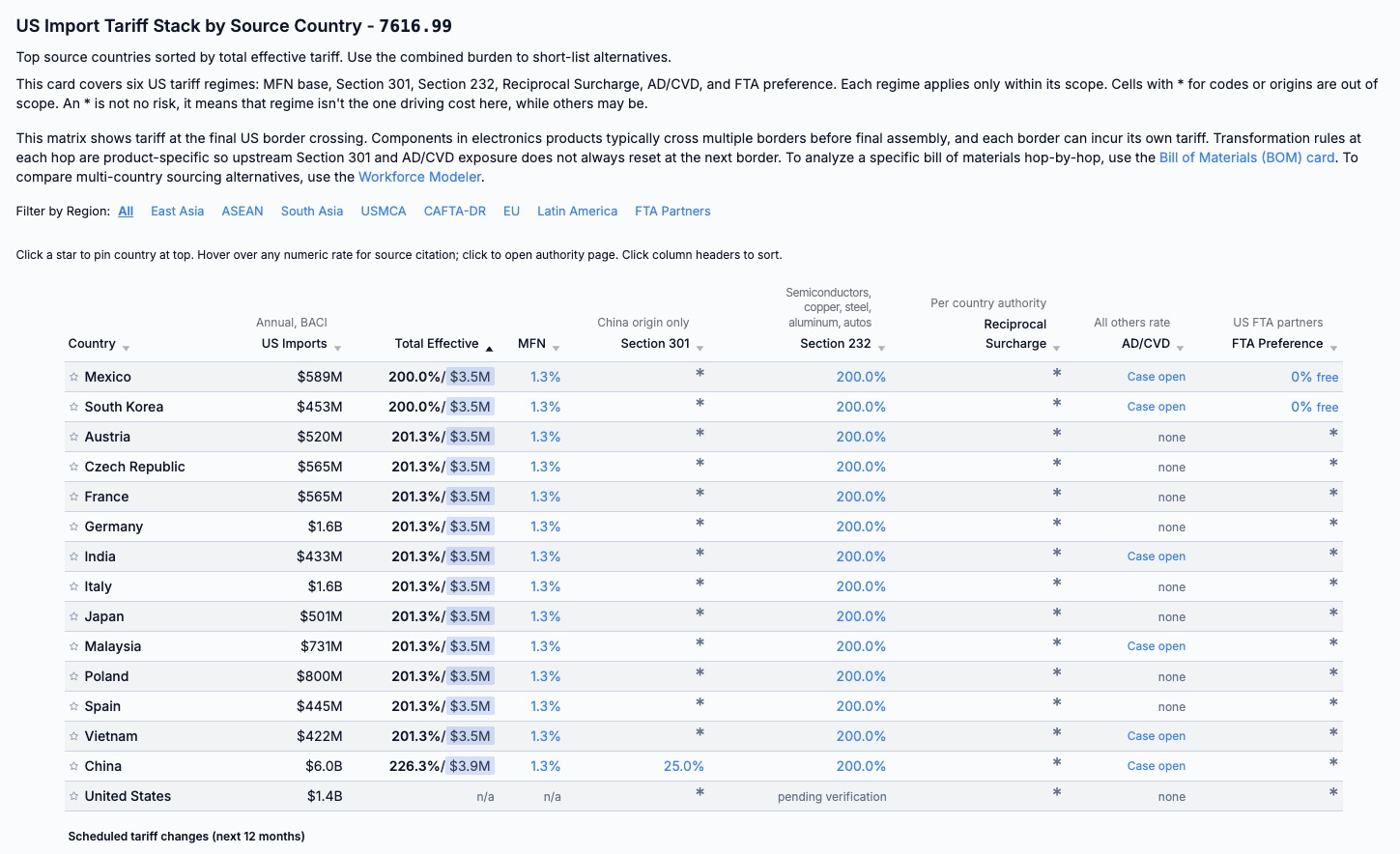
Server rack frames, liquid-cooling distribution unit enclosures, GPU and accelerator heat sinks, and rectifier housings face a Section 232 surcharge from every major source country, plus active AD/CVD orders on key electronics-sourcing origins. TariffVault surfaces the combined burden across countries, regimes, and forward-looking risk in a single matrix.
Look Up Your HTS Code. Free.
View Pricing
Enter any HTS code. No login. No credit card. Results in seconds.
Data Center Builds Face Tariff Exposure at Every Layer of the Rack
Section 301 tariffs compound across compute, networking, power, and cooling. A 3% rate difference per server lands as six or seven figures at hyperscale volumes.
Section 301 at Scale
Section 301 tariffs apply to Chinese-origin server power supplies, rack PDUs, optical transceivers, and cooling controllers under HTS chapters 84 and 85. A tariff on thousands of transceivers or hundreds of rack power supplies adds millions to a single buildout. The tariff applies per unit, across every rack, in every facility, on every refresh.
Optical Transceiver Concentration Risk
The global optical transceiver market is concentrated in Chinese manufacturing. Transceivers are high-volume consumables, replaced throughout the facility lifecycle, so Section 301 hits every replacement module too. Alternatives in Taiwan, Japan, and Thailand exist at higher unit cost and with capacity that cannot absorb hyperscale demand overnight.
Tariff Stacking Across the Rack
A single server rack contains compute nodes (8471), switching equipment (8517), optical transceivers (8517), power supplies (8504), PDUs (8537), and cooling units (8415, 8418). Each component enters under a different HTS code with different tariff rates and different Section 301 status. Combined tariff exposure per rack varies by vendor, configuration, and country of origin for each subassembly. A single blended rate across the BOM points cost-management at the wrong category.
From HTS Code to Sourcing Strategy
Start free with any HTS code. The paid tier opens the full atlas and modeler.
One license includes all tools and features. One-time payment. No subscriptions. No auto-renewals.
Built for the Decisions Data Center Procurement Teams Actually Make
Optical Transceiver Fleet Sourcing
A facility deploys thousands of optical transceivers across spine-leaf fabric. Chinese-origin modules carry the Section 301 tariff. Non-Chinese alternatives from Taiwan, Japan, and Thailand avoid the tariff but cost more per unit. The report shows the tariff delta per HTS code by country of origin. The modeler multiplies the per-module tariff by the deployment volume to surface total annual exposure.
Server Power Supply and PDU Sourcing
Chinese-origin rack power supplies and PDUs carry a Section 301 tariff. Alternatives manufactured in Taiwan and Vietnam avoid the tariff. The report shows tariff per HTS code for each origin country. The modeler computes total exposure across hundreds of racks in a buildout, layering in landed cost per unit, transition cost for qualifying new vendors, and break-even timeline for the supply shift.
Network Switching Equipment BOM Analysis
Switches and routers contain PCBAs, ASICs, optical modules, fans, and power supplies from multiple countries. Each subassembly has separate tariff classification. A single switch may contain components from three or four origin countries, each entering under a different HTS code with different Section 301 status. TariffVault breaks down tariff per component origin across the full BOM.
From the Team Behind VentureOutsource.com
VentureOutsource has reported on contract electronics manufacturing sourcing for over two decades, read by OEM and EMS sourcing teams across the industry.
“I am impressed with the valuable expertise Venture Outsource has obtained on the industry. They command a good depth of knowledge with useful industry insight. Just what I expect from a reliable firm.”
Robert Kronser, CTO, Plexus
See What Your HTS Code Actually Costs You
No login. No credit card. Enter your HTS code and see what it actually costs.
Section 301 tariffs compound across every rack, every facility, every refresh cycle. Tariff exposure scales linearly with deployment volume in data center infrastructure.
Run Report
8517.62.0090
8504.40.9570
8471.50.0150
8537.10.9170
View Pricing
One-time payment. No subscriptions. No auto-renewals.