


EMS Manufacturing Sourcing Strategy, Quantified by HTS Code
Tariff rate data, country comparisons, and corridor risk for both sides of OEM and EMS conversations.
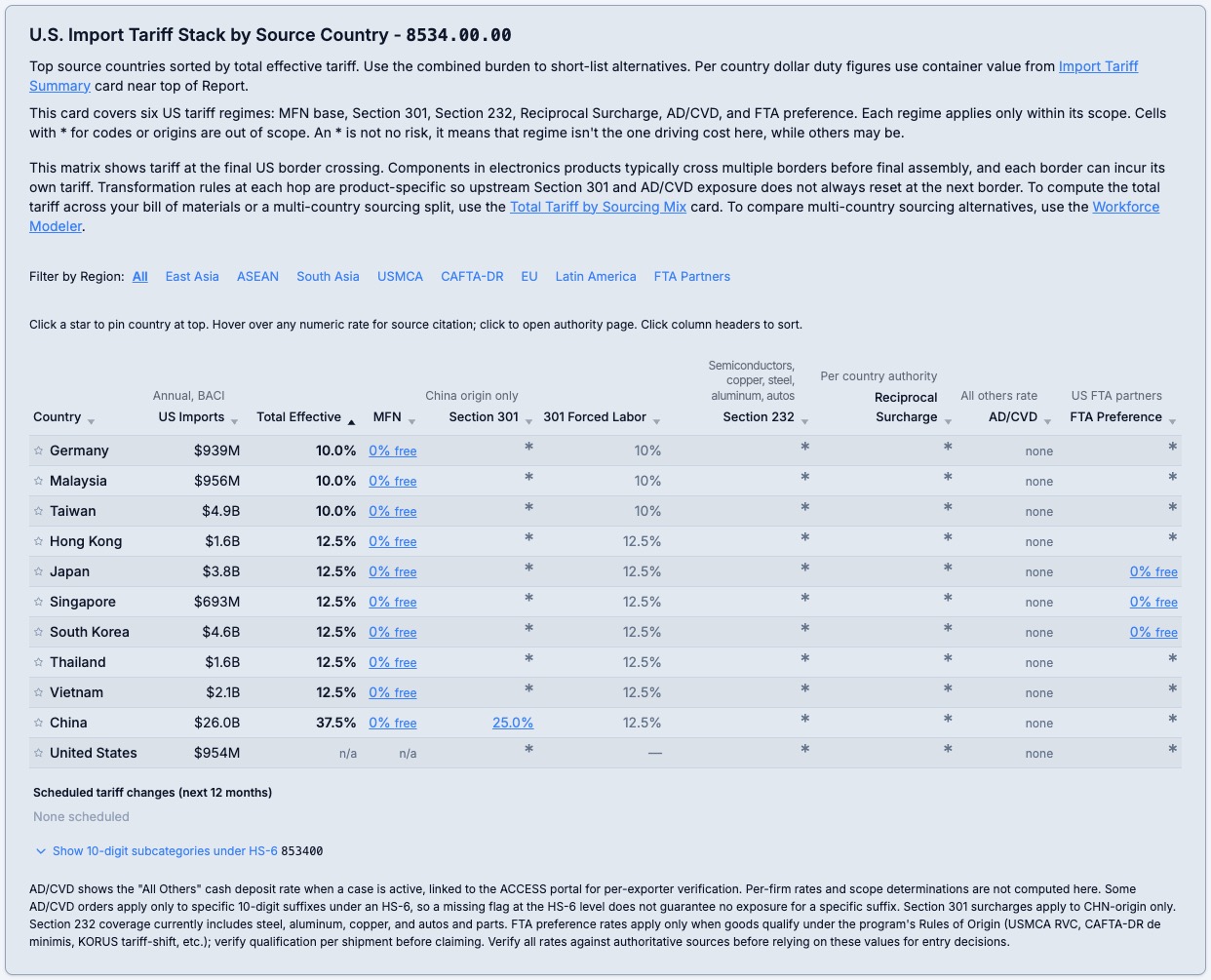
Custom product enclosures, PCB shielding cans, thermal management chassis, and finished-goods housings face a Section 232 surcharge from every major source country, plus active AD/CVD orders on key electronics-sourcing origins. TariffVault surfaces the combined burden across countries, regimes, and forward-looking risk in a single matrix.
Look Up Your HTS Code. Free.
View Pricing
Enter any HTS code. No login. No credit card. Results in seconds.
The Tariff Data Problem in EMS Sourcing
Tariff Rates Change Faster Than Spreadsheets Update
Tariff actions, exclusion modifications, and Section 301 rate changes each shift the effective tariff on a specific HTS code from a specific origin. A rate that was current last quarter is often wrong this quarter. Sourcing decisions built on stale rates carry the wrong number into every downstream calculation.
The Effective Rate Is Five Layers Deep
MFN base rate. Section 301 surcharge. Active exclusion status. AD/CVD order. Trade program eligibility. The actual tariff for a single HTS code from a single origin is a stack of five layers. Each layer comes from a different federal source. Each one changes on a different timeline. Assembling the complete rate is tedious enough that most teams default to approximations.
Corridor Risk Stays Invisible Until a Disruption Lands
Chokepoint exposure, single-source concentration, and geopolitical instability are measurable. None of them show up in a spreadsheet of supplier prices. A corridor slowdown that halts component flow for six weeks reads in public data before it happens. The atlas pulls those signals into one view.
Tariff pass-through conversations move faster when both sides reference the same HTS-level data.
From HTS Code to Sourcing Strategy
Start free with any HTS code. The paid tier opens the full atlas and modeler.
One license includes all tools and features. One-time payment. No subscriptions. No auto-renewals.
Built for EMS Sourcing Decision Makers
Section 301 Impact Quantification
A tariff action hits China-origin passive components. The report shows the effective tariff rate and the delta by alternative origin. The modeler quantifies annual exposure across the program. The atlas maps which inbound corridors carry concentration risk. One HTS code, three angles.
Alternative Origin Comparison
Vietnam, India, Mexico, Taiwan, for the same HS code. The country comparison shows tariff rate, estimated savings per container, and reduction percentage. The landed cost model layers in tariff tariff, quality adjustment, and transition cost. The same numbers sit on both sides of the conversation.
Corridor Risk Before Disruption
The atlas shows corridor risk scores, chokepoint scenarios, and concentration risk for supply corridors serving electronics manufacturing regions. A Strait of Malacca slowdown or port congestion event halts component flow for weeks. The signals that point to it sit in public data ahead of time. The atlas pulls them into one view.
From the Team Behind VentureOutsource.com
VentureOutsource has reported on contract electronics manufacturing sourcing for over two decades, read by OEM and EMS sourcing teams across the industry.
“I am impressed with the valuable expertise Venture Outsource has obtained on the industry. They command a good depth of knowledge with useful industry insight. Just what I expect from a reliable firm.”
Robert Kronser, CTO, Plexus
See What Your HTS Code Actually Costs
No login. No credit card. Enter your HTS code and see what it actually costs.
MFN rates, Section 301 surcharges, AD/CVD orders, exclusion status, and trade program eligibility. Five federal sources assembled into one report, per HTS code.
Run Report
8542.31.0001
8534.00.0040
8532.24.0020
8504.40.9570
View Pricing
One-time payment. No subscriptions. No auto-renewals.