


EV Battery and Energy Storage Tariff Analysis, Quantified by HTS Code
Tariff rates, IRA qualification context, and corridor risk for battery cells, battery management systems (BMS), electric vehicle supply equipment (EVSE), and energy storage systems (ESS).
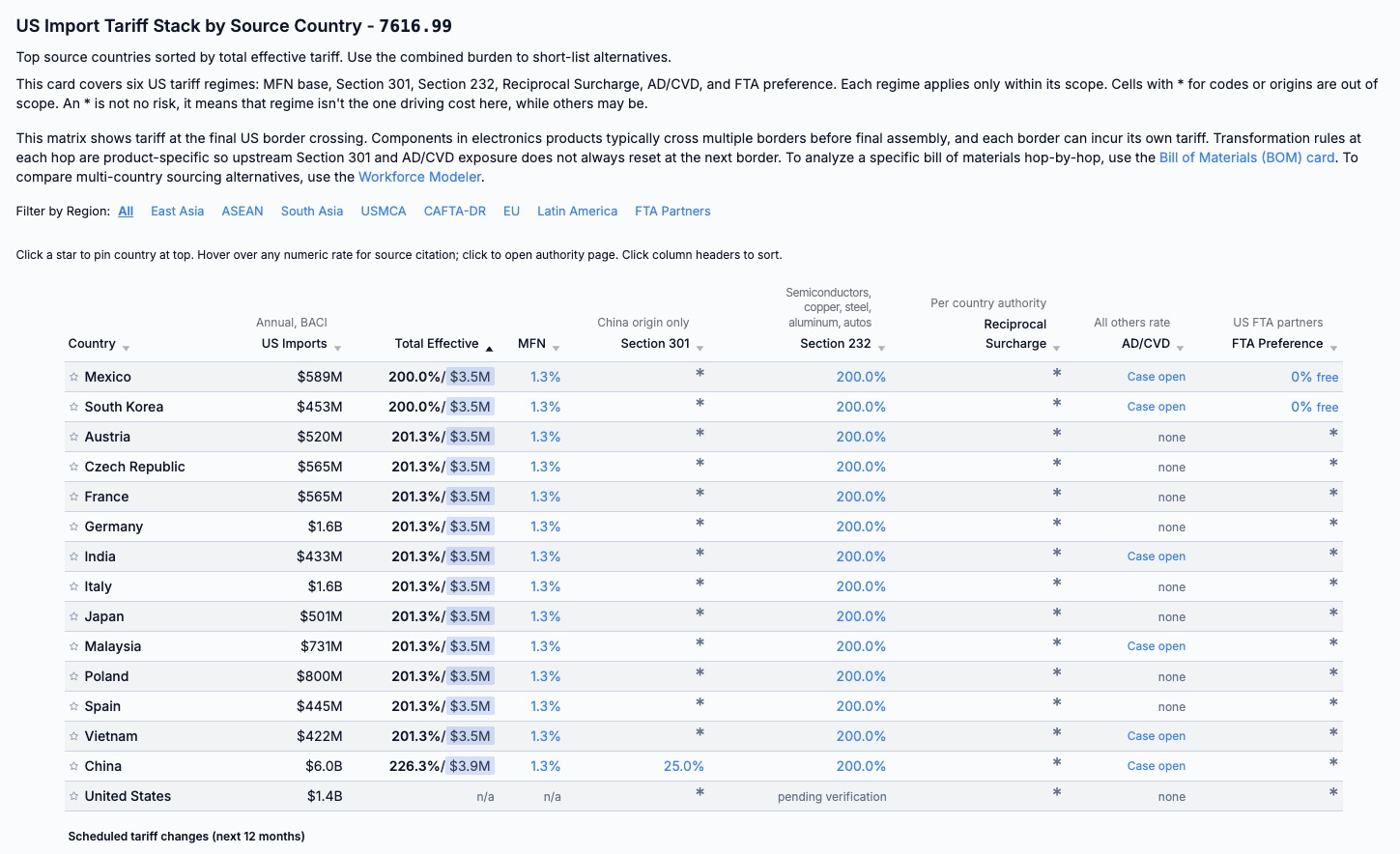
Battery pack enclosures, battery management unit chassis, inverter housings, and thermal management frames face a Section 232 surcharge from every major source country, plus active AD/CVD orders on key electronics-sourcing origins. TariffVault surfaces the combined burden across countries, regimes, and forward-looking risk in a single matrix.
Look Up Your HTS Code. Free.
View Pricing
Enter any HTS code. No login. No credit card. Results in seconds.
In This Vertical, Tariff Classification Determines Eligibility
IRA qualification, FEOC compliance, and domestic content requirements all trace back to HTS codes and country of origin
One Product, Three Tariff Classifications
A battery pack contains critical minerals, cells, and a battery management system. Each layer carries a different HTS code, a different tariff rate, a different Section 301 status, and different country-of-origin rules. Pack-level tariff analysis is meaningless without component-level classification. The effective rate on the assembled product depends on what went into it and where each layer originated.
IRA Thresholds Escalate and FEOC Rules Disqualify
The Inflation Reduction Act requires increasing percentages of battery components and critical minerals from qualifying countries on a rising schedule. Foreign Entity of Concern (FEOC) rules add a pass-fail layer. Certain origins disqualify the vehicle from the federal EV tax credit entirely, regardless of cost. A sourcing decision preserves or kills IRA eligibility based on HTS-level origin data, not supplier declarations. A Chinese-owned cell factory in Hungary still triggers FEOC disqualification.
Supply Chain Concentration Beyond Any Other Vertical
China controls the vast majority of global cathode, anode, separator, and electrolyte production. Graphite refining, lithium processing, and cobalt chemical conversion are concentrated in ways that make semiconductor supply chains look diversified. This concentration is the reason IRA and FEOC rules exist, and the reason origin-level tariff data matters more here than in any other electronics category.
From HTS Code to Sourcing Strategy
Start free with any HTS code. The paid tier opens the full atlas and modeler.
One license includes all tools and features. One-time payment. No subscriptions. No auto-renewals.
Built for EV Battery and Energy Storage Sourcing Decisions
IRA Battery Component Qualification
A battery pack uses Chinese-origin cells. FEOC rules disqualify the vehicle from the federal EV consumer tax credit. Shifting to Korean or Japanese cell suppliers changes the qualification outcome and changes the cost structure with it. The report shows the tariff rate per origin. The modeler computes the landed cost delta. The atlas maps which supply corridors carry concentration risk for each alternative.
Charging Infrastructure Domestic Content
Electric vehicle supply equipment (EVSE) deployed under the NEVI program requires domestic content for federally funded stations. Power modules, cables, connectors, and enclosures each carry separate HTS classifications and separate origin rules. The report identifies tariff rates per component. The modeler quantifies what domestic versus imported sourcing costs across the full charger bill of materials.
Critical Mineral Origin for IRA Compliance
IRA critical mineral percentage thresholds escalate annually on a rising schedule. Graphite from China, lithium from Chile, cobalt from the DRC. Each origin carries a different tariff rate, a different FEOC status, and a different corridor risk profile. Shifting mineral sourcing to Australia, Canada, or Argentina changes qualification math and cost at the same time. TariffVault quantifies both sides.
From the Team Behind VentureOutsource.com
VentureOutsource has reported on contract electronics manufacturing sourcing for over two decades, read by OEM and EMS sourcing teams across the industry.
“I am impressed with the valuable expertise Venture Outsource has obtained on the industry. They command a good depth of knowledge with useful industry insight. Just what I expect from a reliable firm.”
Robert Kronser, CTO, Plexus
See What Your HTS Code Actually Costs You
No login. No credit card. Enter your HTS code and see what it actually costs.
IRA critical mineral thresholds escalate annually on a rising schedule. FEOC enforcement narrows qualifying origins. Section 301 rates on Chinese-origin battery components have risen. The tariff data behind every sourcing decision in this vertical changes on multiple timelines at once.
Run Report
8507.60.0010
8504.40.9570
8537.10.9170
2504.10.1000
View Pricing
One-time payment. No subscriptions. No auto-renewals.