


Your Telecom Equipment Tariff Exposure, Quantified by HTS Code
Tariff rates, trade flow analysis, and corridor risk for optical transceivers, radio access equipment, switches, routers, and broadband infrastructure.
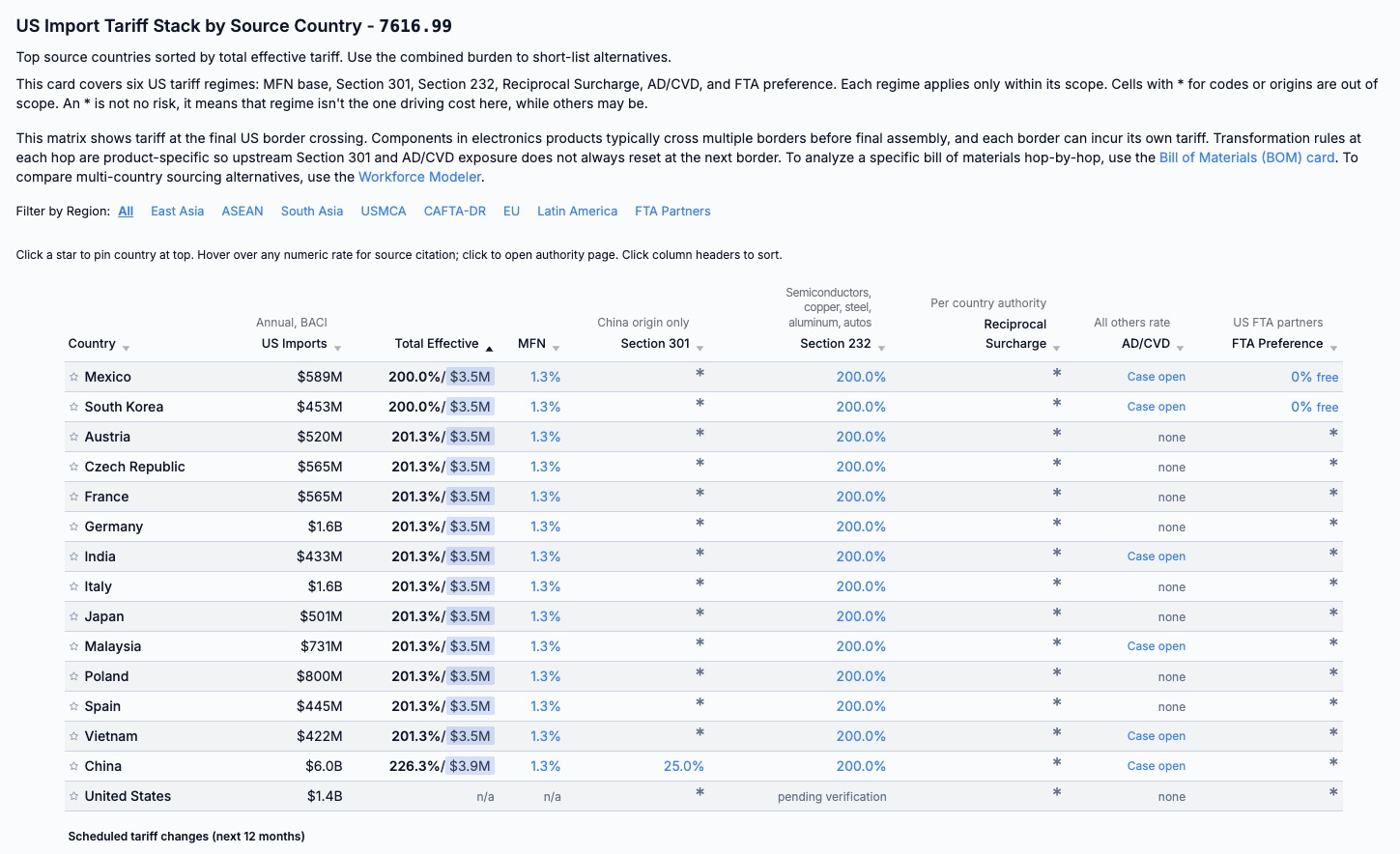
Cell tower enclosures, fiber optic distribution cabinets, networking switch chassis, and optical transceiver housings face a Section 232 surcharge from every major source country, plus active AD/CVD orders on key electronics-sourcing origins. TariffVault surfaces the combined burden across countries, regimes, and forward-looking risk in a single matrix.
Look Up Your HTS Code. Free.
View Pricing
Enter any HTS code. No login. No credit card. Results in seconds.
Telecom Equipment Sourcing Teams Face a Three-Front Tariff Problem
Section 301 tariffs, rip-and-replace mandates, and BEAD Act compliance are reshaping telecom sourcing economics simultaneously
Section 301 on Chinese Networking Components
Section 301 tariffs apply to Chinese-origin optical transceivers, switching ICs, RF components, and printed circuit board assemblies under HTS 8517. Rates shift as exclusions open and close, so the report shows the current rate per origin. Equipment assembled by non-Chinese OEMs carries the tariff when Chinese-origin subassemblies constitute the imported article. Optical transceiver modules, the highest-volume consumable in network deployments, are concentrated in Chinese manufacturing.
Rip-and-Replace Mandate Sourcing Pressure
The Secure and Trusted Communications Networks Act requires carriers to remove Huawei and ZTE equipment from US networks. The FCC’s Reimbursement Program funds replacement, but carriers must source alternative equipment that meets FCC equipment authorization requirements. Replacement hardware from non-Chinese vendors still contains Chinese-origin components, triggering the same Section 301 tariffs on subassemblies.
BEAD Act Build America Provisions
The Broadband Equity, Access, and Deployment (BEAD) Program requires Build America, Buy America (BABA) compliance for funded infrastructure. Manufactured products must be produced in the US, and iron, steel, and aluminum must be domestically sourced. Equipment that qualifies under BABA still faces import tariffs on non-US components used in domestic assembly. Tariff exposure shifts from the finished product to the bill of materials.
From HTS Code to Sourcing Strategy
Start free with any HTS code. The paid tier opens the full atlas and modeler.
One license includes all tools and features. One-time payment. No subscriptions. No auto-renewals.
Built for the Decisions Telecom Sourcing Teams Actually Make
Optical Transceiver Sourcing, China vs Alternatives
Your network deployments consume thousands of optical transceiver modules per year across every speed grade. Chinese manufacturers dominate global transceiver production. The Section 301 tariff applies per module at every data rate. Alternatives exist in Taiwan, Japan, and Thailand but at higher unit costs and longer lead times. The report shows the tariff rate per origin. The modeler calculates total cost across your annual deployment volume.
Huawei/ZTE Replacement Equipment Sourcing
Your network is replacing Huawei radio units and baseband equipment under the FCC mandate. Replacement vendors (Nokia, Ericsson, Samsung) manufacture in multiple countries. Finnish-designed equipment assembled in China carries Section 301. The same product assembled in India or Vietnam does not. The report identifies the tariff treatment per HTS code. The atlas maps corridor risk for each vendor’s supply chain.
BEAD-Funded Broadband Equipment Compliance
Your ISP is deploying fiber access equipment with BEAD Act funding. Build America, Buy America requires domestically manufactured products, but the PCBAs, optical modules, and power supplies inside the chassis are imported. Each imported component enters under its own HTS code with its own tariff rate. TariffVault identifies the tariff exposure on your component BOM so you can price the deployment accurately before submitting your BEAD application.
From the Team Behind VentureOutsource.com
VentureOutsource has reported on contract electronics manufacturing sourcing for over two decades, read by OEM and EMS sourcing teams across the industry.
“I am impressed with the valuable expertise Venture Outsource has obtained on the industry. They command a good depth of knowledge with useful industry insight. Just what I expect from a reliable firm.”
Robert Kronser, CTO, Plexus
See What Your HTS Code Actually Costs You
No login. No credit card. Enter your HTS code and see what it actually costs.
Telecom equipment faces Section 301 tariffs on Chinese-origin components, FCC equipment authorization requirements on replacements, and BABA domestic content rules on federally funded deployments. Each program carries its own compliance burden.
Run Report
8517.62.0090
8517.69.0000
8544.70.0000
8525.60.0010
View Pricing
One-time payment. No subscriptions. No auto-renewals.