
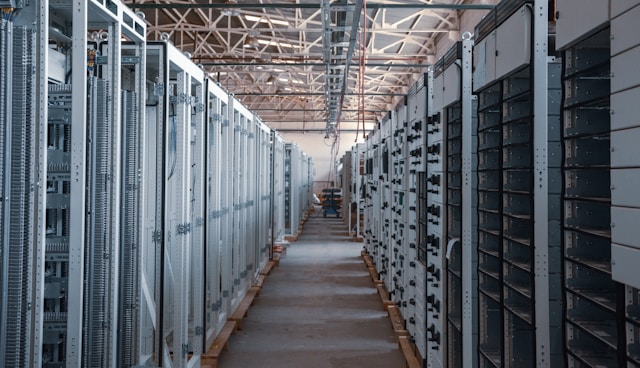
Every connection inside a modern data center – server to switch, switch to router, building to building, campus to long-haul fiber – runs through an optical transceiver. A single hyperscale facility can deploy 50,000 to 100,000 transceivers across its interconnect fabric. The component is small, relatively low-cost per unit, and easy to overlook in a tariff exposure review. It should not be overlooked. A disproportionate share of global optical transceiver manufacturing is concentrated in China, and Section 301 tariffs at 25% apply to Chinese-origin transceivers classified under HTS 8517.62.
Concentration problem precedes tariff problem
China accounts for a significant majority of global optical transceiver production capacity. Companies like Hisense Broadband, Source Photonics (now owned by a Chinese entity), and several ODMs in Shenzhen and Wuhan produce transceivers for data center operators worldwide. Even name-brand transceiver vendors with US or Japanese headquarters often contract manufacturing to Chinese facilities. The label on the box may say one country; the country of origin for customs purposes follows where substantial transformation occurred.
This concentration means data center operators face a dual constraint. The tariff exposure is real and immediate – 25% on every Chinese-origin transceiver entering the US. But the alternative supply base is limited. Finisar’s heritage manufacturing in the US, Sumitomo and Fujitsu plants in Japan, and a small but growing capacity in Thailand and Malaysia represent the non-China options. None of these alternatives currently match China’s volume capacity, and lead times for non-Chinese transceivers can stretch months beyond standard.
Operators who decide to shift sourcing away from Chinese-origin transceivers to avoid the 25% Section 301 duty often find the capacity simply is not available – or the premium pricing on constrained non-Chinese supply erodes most of the tariff savings. The sourcing decision becomes a three-way calculation: pay the 25% duty on Chinese-origin units, pay a supply-constrained premium for non-Chinese units, or wait for capacity expansion in alternative geographies and accept deployment delays.
Unit cost is modest but volume is enormous
A 400G QSFP-DD transceiver can cost anywhere from $150 to $600 depending on reach, vendor, and generation. At the single-unit level, a 25% tariff adds $37 to $150 per transceiver – a line item most procurement teams would not flag. At data center scale, the arithmetic changes. A facility deploying 60,000 transceivers at an average cost of $300 per unit carries a base procurement cost of $18 million. A 25% Section 301 tariff on Chinese-origin units adds $4.5 million in duties to a single facility’s interconnect layer.
Operators building multiple facilities per year – the standard cadence for hyperscale providers – face transceiver tariff exposure in the tens of millions annually on a component category most finance teams classify as consumable.
Classification adds another layer of risk
Transceiver technology evolves on roughly 18-month cycles. Each generation introduces new form factors, data rates, and optical specifications. As the technology changes, HTS classification may shift. A pluggable transceiver module and a board-mounted optical engine may not classify under the same subheading, even if they serve identical interconnect functions. An operator standardizing procurement on one HTS classification today may find next-generation transceivers require a different code – with a different duty rate and different Section 301 treatment.
This is not a theoretical risk. Customs classification disputes on optical networking components have generated enforcement actions and retroactive duty assessments. Getting the classification right before signing procurement contracts is cheaper than resolving a customs audit after 200,000 units have already cleared.
Exact duty rates before contract commitment
A *data center HTS code tariff analysis* returns the current duty rate, Section 301 status, and country-of-origin comparison for any transceiver HTS classification. Running the lookup before locking a supplier contract gives procurement teams the actual landed cost per unit, per origin – not a blended assumption across the interconnect BOM.
In a component category where supply is concentrated, tariff rates are punitive, and technology shifts can change the classification, per-code visibility is not optional. It is the difference between a procurement decision based on unit price and one based on actual landed cost.


