
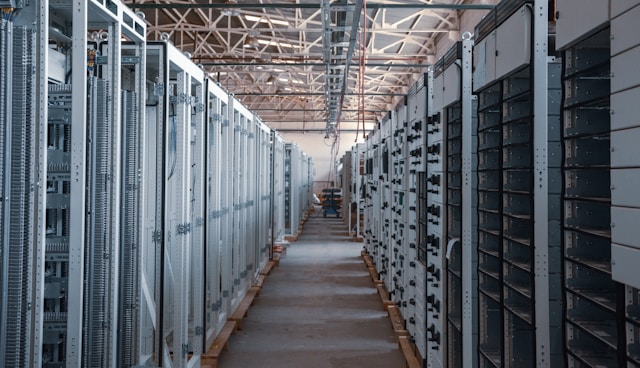
A 3% duty rate difference on a single rack-mount server barely registers in a procurement review. On a hyperscale buildout – 5,000 to 50,000 servers in a single facility – the same 3% difference compounds into six or seven figures of unanticipated tariff cost. The math is straightforward, but most infrastructure procurement teams never run it at the line-item level where it matters.
Blended rate assumptions hide where cost concentrates
Every data center rack is a stack of components classified under different HTS headings with different duty rate profiles. Servers fall under HTS 8471, networking switches and routing equipment under 8517, power supplies and transformers under 8504, power distribution units and electrical control panels under 8537, and precision cooling systems under 8418. Each heading carries its own base MFN duty rate, and each faces different treatment under Section 301 and other trade actions depending on country of origin.
Procurement teams building infrastructure BOMs routinely apply a single blended tariff rate across the entire equipment manifest. The blended number looks reasonable in a budget deck. It masks the actual cost distribution. At hyperscale volumes, the categories with the highest effective duty rates dominate total exposure – and those categories are rarely the ones the team assumed were driving cost.
SEE ALSO
Optical transceiver sourcing and tariff exposure: China concentration in data center interconnects
Consider a simplified buildout: 10,000 servers at $8,000 each, 2,000 top-of-rack switches at $12,000 each, and supporting power and cooling infrastructure totaling another $30 million. A procurement team applying a blended 2.5% tariff rate across the full $134 million BOM estimates $3.35 million in duties. But if the switches are Chinese-origin and subject to 25% Section 301 tariffs under HTS 8517, the switching layer alone generates $6 million in duties – nearly double the blended estimate for the entire project. The blended number did not just underestimate; it pointed cost management effort at the wrong equipment category entirely.
Section 301 makes origin the variable, not just classification
For data center equipment sourced from China, Section 301 tariffs at 25% apply across many of the relevant HTS headings. A server assembled in China under 8471 and a power supply manufactured in China under 8504 both face the same 25% surcharge on top of base MFN rates. The same server assembled in Taiwan or Mexico may enter at base MFN rates only.
This means two identical hardware configurations – same vendor, same specs, same part numbers – can carry duty rate differences of 20 or more percentage points depending on where final assembly occurs. At the single-unit level, the difference is a rounding error in a capital budget. At 10,000 units, it is a procurement decision worth millions.
We see this pattern repeatedly in infrastructure sourcing: operators negotiate hard on unit pricing, lock a vendor, and discover the tariff exposure only when the customs broker processes the first container. By then, the purchase orders are committed, and the duty cost is baked in.
Per-HTS-code visibility changes the procurement sequence
The fix is not complex, but it requires discipline most procurement organizations skip. Each component category in the infrastructure BOM needs its own tariff lookup by 10-digit HTS code and country of origin. Power supplies from one country, switches from another, servers from a third – each line item carries a different effective duty rate, and each needs to be costed individually before the BOM is finalized.
A *data center equipment tariff rate lookup* returns the current duty rate, Section 301 and Section 232 applicability, and country-of-origin comparisons for any HTS classification in the data center equipment stack. Running the top 15 or 20 line items in an infrastructure BOM takes minutes and produces a tariff cost map no blended estimate can replicate.
At hyperscale, small rate differences stop being small. A $200 duty delta per server, invisible in a unit-level review, becomes $2 million across a 10,000-unit deployment. The question is whether procurement discovers the concentration before or after the purchase orders ship.



