
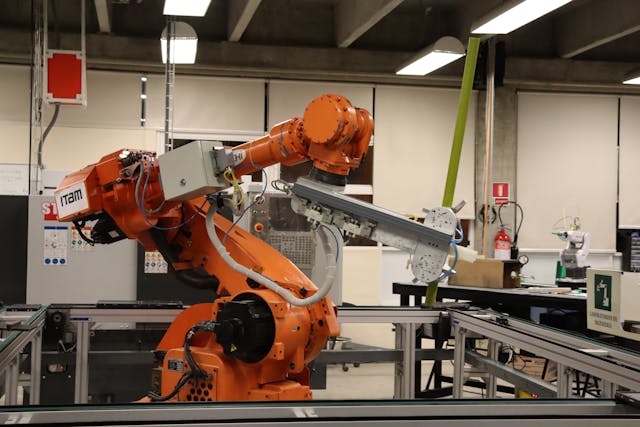
Chinese robotics manufacturers are selling six-axis articulated arms at 30-50% below comparable Japanese and European systems. Companies like Estun, STEP Electric, and EFORT have closed the performance gap enough to win evaluations at price-sensitive OEMs and contract manufacturers – particularly for palletizing, machine tending, and basic assembly applications where cycle time requirements are forgiving. Section 301 tariffs at 25% on Chinese-origin automation equipment cut into the price advantage but do not eliminate it. A Chinese arm priced 40% below a Fanuc equivalent still lands 15% cheaper after duty. The math looks simple until you examine how classification works – because the tariff outcome depends entirely on whether you import a complete system or bring in components separately.
Complete system import under HTS 8479.50
A fully assembled Chinese-origin industrial robot – arm, servo motors, drives, controller, and teach pendant shipped as a functional unit – classifies under HTS 8479.50 (industrial robots) or 8479.89 (other machines with individual functions) depending on configuration. Section 301 List 3 at 25% applies to the full declared customs value. If the system’s FOB price is $38,000, the duty adds $9,500. The landed cost comparison against a Fanuc M-20iD at $55,000 FOB (entering duty-free from Japan under MFN rates) narrows to $47,500 vs. $55,000 – still favorable for the Chinese system, but by a smaller margin than the purchase order suggests.
This is the straightforward scenario. One HTS code, one duty rate, one country of origin. Procurement teams running this calculation correctly still capture the price advantage and can make an informed buy decision. The problem is the teams running it incorrectly – or not running it at all, budgeting the $38,000 FOB and discovering the $9,500 duty after the equipment ships.
Component-level import creates a different tariff map
The calculation changes when a system integrator – or the Chinese manufacturer itself – ships components separately rather than as a complete robot. A servo motor classifies under HTS 8501 (electric motors). A power supply or servo drive falls under HTS 8504. A control panel or robot controller lands under HTS 8537. Each heading carries its own base MFN rate, and each faces Section 301 exposure independently based on origin.
Importing components separately does not automatically reduce total duty. In some configurations it increases it. A servo motor under 8501.52 from China faces 25% Section 301 on its declared value. A power supply under 8504.40 faces the same 25%. The controller under 8537.10 – also 25%. If the sum of component duties exceeds the duty on the complete system, the component path costs more. If certain components source from Japan or Germany – servo drives from Yaskawa, a controller from Siemens – those items enter at MFN rates with no Section 301 exposure, and the blended duty across the cell drops.
Classification decision is a sourcing decision
The choice between importing a complete Chinese system and importing a mixed-origin component set is not just a logistics question. It is a tariff planning decision with direct cost consequences. Two configurations can deliver identical technical capability with materially different landed costs based solely on how components are classified and where each one originates.
We see procurement teams evaluate Chinese robotics alternatives on FOB price alone, treating the 25% duty as a flat adder applied uniformly. The reality is more granular. A system integrator assembling a cell from a Chinese arm, Japanese servos, and a German PLC faces three different duty profiles across the same workstation. The integrator importing a complete Chinese system faces one rate on a higher base value. Neither approach is universally cheaper – the answer depends on the specific HTS classification and origin of every major component.
Per-code verification before the purchase order
The gap between estimated and actual duty on robotics equipment runs 5-15% of system cost in the cases we review. The gap exists because teams apply a single tariff assumption to a multi-component, multi-origin purchase. A *robotics automation tariff rate lookup* returns the current duty rate, Section 301 status, and country-of-origin comparison for each HTS classification in the equipment list – 8479.50 for the complete arm, 8501 for motors, 8504 for power supplies, 8537 for controllers. Running the lookup before the purchase order closes converts a tariff estimate into a tariff fact, and the difference between the two is where procurement teams either capture or forfeit the cost advantage driving the Chinese robotics evaluation in the first place.




Comments