
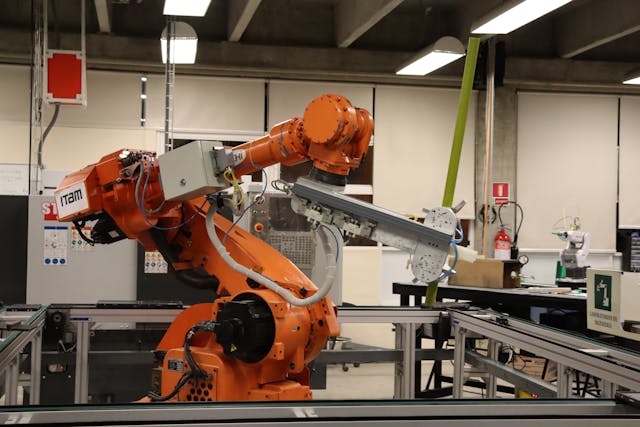
An automation cell is not one product. It is five, six, sometimes eight distinct components sourced from different manufacturers in different countries, integrated on a factory floor, and validated as a single functional unit. A robot arm from Fanuc in Japan. Servo drives from Yaskawa in Japan or Siemens in Germany. A PLC from Rockwell in the US or Beckhoff in Germany. A vision system from Cognex in the US, Keyence in Japan, or Hikrobot in China. A power supply from Mean Well in Taiwan or a Chinese contract manufacturer. End-of-arm tooling from any of a dozen countries. Each component classifies under a different HTS heading. Each carries a different duty rate. Each faces different trade program exposure based on where it was manufactured. Procurement teams evaluating automation cells on total system price are modeling tariff cost incorrectly unless they are running the duty calculation per component, per origin.
Six components, six duty rates
Consider a realistic pick-and-place cell for electronics assembly. The robot arm – a Fanuc M-10iD – classifies under HTS 8479.50, enters from Japan at MFN rates, no Section 301 exposure. The servo motors integral to the arm enter as part of the same classification. The standalone servo drives for auxiliary axes classify under HTS 8501.52 (electric motors) – Japanese origin, again MFN with no 301 adder. The PLC – a Beckhoff CX series from Germany – classifies under HTS 8537.10 (programmable controllers), MFN entry. So far, the cell carries minimal tariff friction. Standard MFN rates on these headings run 0-2.5%.
SEE ALSO
Section 301 tariffs on robotics: complete Chinese systems vs component level duty exposure
Now swap the vision system. A Hikrobot industrial camera from China classifies under HTS 8525.89 (television cameras and digital cameras). Section 301 List 3 applies at 25% on Chinese-origin goods in this heading. A $4,200 vision system adds $1,050 in duty. The power supply – a Chinese-origin switching unit under HTS 8504.40 – carries the same 25% Section 301 rate. At $800 declared value, the duty is $200. Two components out of six are driving the entire Section 301 exposure for the cell. The other four enter at negligible rates.
Same cell, different origin profile, different cost
Replace the Fanuc arm with an Estun robot from China. The arm now classifies under the same HTS 8479.50 but enters as a Chinese-origin product – 25% Section 301 on a $36,000 system value adds $9,000. The Chinese vision system still adds $1,050. The Chinese power supply still adds $200. Total Section 301 exposure on this version of the cell: $10,250. The first configuration – Japanese arm, Chinese vision and power supply – carried $1,250. Same functional cell. Same throughput capability. A $9,000 tariff delta driven entirely by the origin of the robot arm.
This is where cell-level tariff modeling matters. Procurement teams comparing a $36,000 Chinese arm against a $55,000 Fanuc arm see a $19,000 FOB gap. After Section 301, the gap narrows to $10,000. Factor in the integration cost differential – the Fanuc arm has deeper application engineering support, broader peripheral compatibility, and an installed base the maintenance team already knows – and the economic case for the Chinese alternative weakens considerably. But none of this analysis is possible without per-component duty rates.
Safety revalidation compounds switching cost
Automation cells are not modular in the way procurement teams sometimes assume. ANSI/RIA 15.06 – the safety standard governing robotic workcell design – requires a risk assessment for each cell configuration. Changing the robot arm manufacturer is not a drop-in substitution. It triggers safety revalidation: updated risk assessment, modified safeguarding, revised emergency stop circuits, and potentially new safety-rated monitored stop functions. Revalidation adds $15,000-$40,000 in engineering cost and 8-16 weeks of lead time. A tariff-motivated arm swap only makes economic sense if duty savings over the equipment lifecycle exceed revalidation and integration costs – a calculation requiring accurate per-component tariff data as the starting input.
Cell-level tariff modeling starts with per-code lookups
Automation cells typically integrate components from three to five different countries of origin. Applying a single blended tariff rate to the cell purchase order misses the concentration of duty exposure in specific components – often the ones easiest to re-source. An *automation equipment HTS code tariff analysis* returns the current duty rate, Section 301 status, and origin-specific exposure for each component classification: 8479.50 for robot arms, 8501.52 for servo motors, 8537.10 for controllers, 8525.89 for vision systems, 8504.40 for power supplies. The per-code data turns a system-level price comparison into a component-level landed cost model – and the component level is where the real sourcing decisions are made.


Comments