
The group of contract manufacturers known as electronics manufacturing services (EMS) providers has long coveted the business of medical device manufacturers, and in many respects that fit is a good one.
The number of medical devices that make use of sophisticated software and integrated circuitry has been on the rise for more than a decade.
Medtech manufacturers can find it difficult to justify full-time staffing for assembly of complex products that are produced in relatively low volumes. And, especially important for EMS providers, this class of subcontracting would seem to hold the promise of good profit margins.
In other respects, however, the connection between medtech manufacturers and EMS providers is a distant one. Medical product manufacturing is a global industry that is expected to reach nearly $190 billion in 2004, with estimated annual growth of 6.5%.(1)
But the amount that medtech companies spend on manufacturing is only a fraction of that sum—and even less is devoted specifically to medical electronics.
EMS providers that have taken the time to review such numbers might be forgiven for losing the gleam of dollar signs in their eyes.
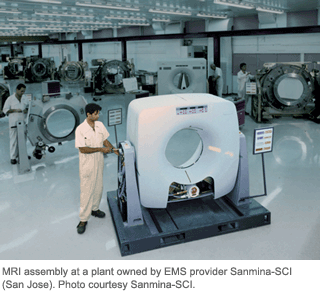
Meanwhile, the global market for electronics manufacturing services in 2003 was roughly $90 billion, a total that is expected to grow to $132 billion by 2008.(2) So even if EMS providers don’t exactly consider medtech companies to be small potatoes, many have adopted a circumspect attitude toward the revenue potential of the device industry.
RELATED DOCUMENTS
Contract Agreement for EMS Medical Device Design Services (7 pages)
Contract Agreement for EMS Medical Device Manufacturing Services (14 pages)
But all of that could be changing. This article looks at emerging trends affecting the development of medical electronics and how they may also influence the relationships among medtech manufacturers and EMS providers.
Changing Drivers
In the past, the primary force impelling medical device manufacturers to consider outsourcing their electronics manufacturing operations has been cost. Outsourcing such operations to EMS providers yields average cost savings of 10–15% when compared with a manufacturer’s costs for building and maintaining equivalent services in-house.(3)
However, EMS providers have been active in promoting other benefits of outsourcing as well. At a time when many medtech companies of all sizes have been pressed to minimize unnecessary expenses and eliminate wasteful operations, many functions traditionally performed within a company’s own walls have come under intense scrutiny. In some cases, company leaders have discovered that they can better concentrate on their company’s core competencies if they outsource certain noncore operations. Electronics manufacturing is often considered such an outsourceable function, and EMS providers have benefited from this trend.


